 Yatishara Blog
Guyana’s Fast Pay and UPI go live as oil skews Caribbean growth
Fast Pay launched June 2, 2026 with India-linked UPI architecture. Trinidad and Tobago’s MoU still lags. Oil revenue and World Bank growth figures explain why Guyana’s payments story sits inside a skewed regional economy.
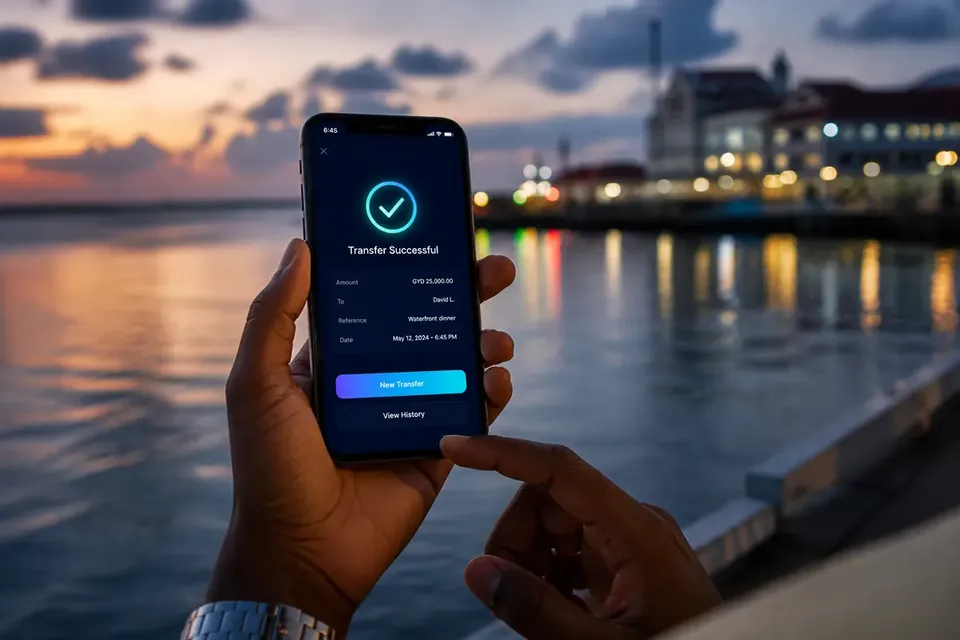
On June 2, 2026, Guyana switched on Fast Pay, a national real-time payments rail that lets customers of participating banks send and receive funds instantly through mobile and internet banking, seven days a week. The same launch package tied Guyana into India’s Unified Payments Interface (UPI) architecture through a partnership with NPCI International Payments Ltd. That combination makes Guyana the first Caribbean country with a live UPI-linked instant payments system, according to reporting by La Caribeña News.
Trinidad and Tobago signed its own memorandum with NPCI International in September 2024. As of Guyana’s go-live date, that MoU had not produced a comparable live rail. The regional contrast is now operational, not rhetorical.
How Fast Pay and UPI fit together
Fast Pay is Guyana’s domestic instant clearing layer. President Mohamed Irfaan Ali announced the June 2 launch at GBTI’s 190th Anniversary Gala in May 2026, according to the Office of the President as cited by La Caribeña News. Customers move money in seconds instead of waiting on batch clearing or branch processing.
UPI is the imported architecture. India’s system routes payments through Virtual Payment Addresses so users do not need to exchange full bank account details for every transfer. La Caribeña News places India’s March 2026 UPI volume at 22.64 billion transactions in a single month, and notes International Monetary Fund attribution that UPI accounts for 49 percent of global real-time payment transactions. India routed roughly US$3.6 trillion through UPI in 2025. Guyana’s GDP is cited in the same piece at about US$40 billion, which is why the export of the model matters more than any claim that Guyana will soon match Indian volume.
The diplomatic path was set earlier. On November 20, 2024, India and Guyana signed ten memoranda of understanding in Georgetown. One covered NPCI International’s work with Guyana’s Ministry of Foreign Affairs on a UPI-like system. Another covered India Stack digital public infrastructure cooperation, as reported by India News Network and summarised by La Caribeña News.
Elsewhere, UPI-linked deployments already span Bhutan, Nepal, Singapore’s PayNow link, Sri Lanka, Mauritius, the UAE, France, Cyprus, and Qatar, with later rollouts flagged for Israel and Japan. Guyana’s claim is regional first-mover status inside CARICOM, not global novelty.
What changes for households and merchants
For households, the practical change is everyday settlement: family transfers, bill payments, splitting costs, and paying a vendor without cash or a card terminal. La Caribeña News emphasises the merchant fee problem that has kept small Caribbean sellers on cash. A Bourda Market vendor or an Anna Regina fisherman who cannot justify card acceptance can, in principle, accept a Fast Pay transfer on a phone they already own.
For banks and the Bank of Guyana, the system creates transaction visibility that batch rails never delivered. Policy analysts often point to Brazil’s Pix as the cleanest comparator. Pix launched in November 2020. By end-2024, Brazil’s central bank figures cited in the La Caribeña piece put active users at 178 million, roughly 91 percent of adults, with US$4.6 trillion in 2024 transaction value. Those are Brazilian measurements, not Guyana forecasts. They show what happens when instant rails become default, not what Guyana’s first months will look like.
Transaction limits for Fast Pay were still listed as to be determined by the Bank of Guyana at launch. Cross-border ambitions, including eventual links toward systems such as Africa’s PAPSS, remain forward-looking rather than live features of day one.
Trinidad and Tobago’s MoU lag
The Caribbean payments race is not symmetric. Trinidad and Tobago’s September 2024 MoU with NPCI International put Port of Spain on the India Stack map months before Guyana’s go-live. Signing is not shipping. As of June 2, 2026, Guyana had an operating rail; Trinidad and Tobago did not.
That gap matters for regional merchants who sell across both markets. Instant domestic settlement in Georgetown does not automatically clear a Port of Spain invoice. Interoperability across Caribbean jurisdictions is still a separate project. Guyana’s lead is real on domestic rails. It does not yet rewrite remittance corridors or CARICOM commerce end to end.
Oil revenues sit beside the payments story
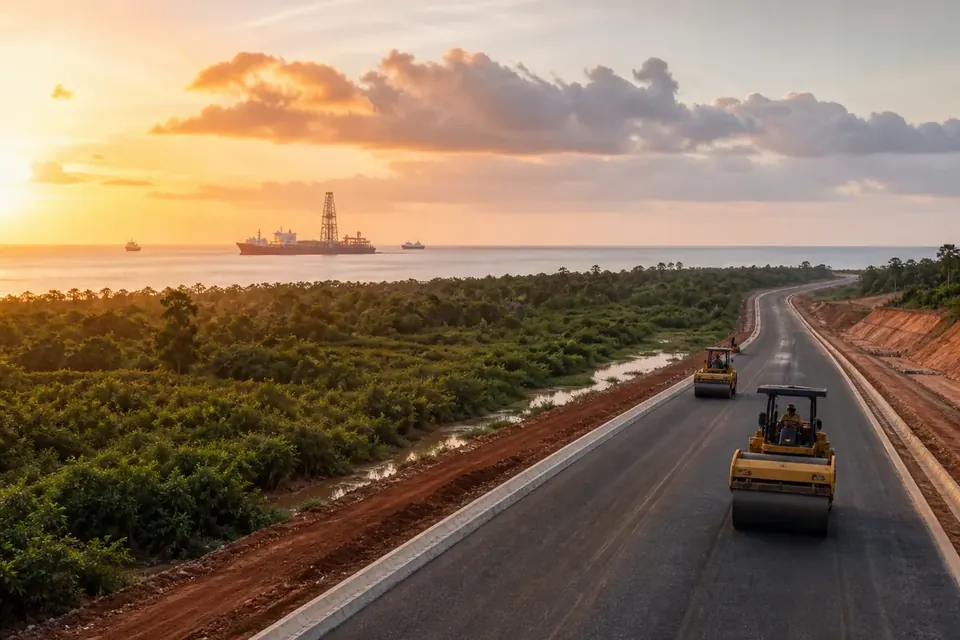
Fast Pay did not appear in a vacuum. Guyana’s fiscal capacity and consumer liquidity are shaped by offshore oil. Official Gazette notifications summarised by OilNOW show US$1.996 billion deposited into the Natural Resource Fund between January and June 2026 from profit oil and royalties.
Of that total, US$1.779 billion (nearly 90 percent) came from Guyana’s share of profit oil. US$218.4 million came from royalties, including US$110.9 million deposited in January and US$107.5 million in April. First-quarter receipts were US$761.7 million. April to June added about US$1.24 billion.
Under the Stabroek Block Production Sharing Agreement, Guyana receives a 2 percent royalty on petroleum produced and a 50 percent share of profit oil after recoverable costs, with both streams flowing into the NRF before budgeted transfers. Four FPSOs (Liza Destiny, Liza Unity, Prosperity, and ONE GUYANA) pushed average first-half 2026 output above 900,000 barrels per day, with Uaru expected to push national production past 1 million b/d later in the year, according to OilNOW.
Separately, ExxonMobil told investors on its July 31, 2026 earnings call that it had recovered roughly US$55 billion of investment and operating costs in Guyana nearly two years earlier than anticipated, according to Kaieteur News. CFO Neil Hansen said that once that recovery is complete, remaining production is shared 50/50 between the contractor group and the government after allowable operating costs. Kaieteur News also notes government silence on the precise timing of the cost-bank clearing and on how future project costs will be ring-fenced. Those are contested fiscal questions. They belong next to the payments story because revenue share and settlement infrastructure are both parts of how money actually moves through Guyana’s economy.
World Bank growth figures: attribute the skew
The January 2026 World Bank Global Economic Prospects report, as covered by INews Guyana, projects Caribbean sub-region growth of 5.2 percent in 2026 and 6.6 percent in 2027. Those averages are oil-skewed. Without Guyana, the same report’s Caribbean residual falls to about 2.9 percent in 2026 and 3.7 percent in 2027.
Guyana alone is projected at 19.6 percent growth in 2026 and 21.9 percent in 2027. That is not the same as saying “the Caribbean is growing at 5 to 7 percent” in a uniform way. Headline regional averages will mislead anyone allocating capital, hiring plans, or merchant demand forecasts across islands without separating Guyana from the rest.
Guyana’s own budget narrative, also summarised by INews Guyana via DPI, pointed to 19.3 percent overall GDP growth in 2025 and a 16.2 percent projection for 2026, with oil production rising 17.9 percent. Non-oil growth was projected at 10.8 percent, with construction at 25.4 percent, manufacturing at 12.9 percent, and agriculture at 7.6 percent. Those are national fiscal projections aligned with, but not identical to, the World Bank’s medium-term path.
Why payments infrastructure matters inside an oil boom
Oil receipts fund infrastructure, health, education, housing, and energy through NRF transfers. Instant payments do something different: they change the unit economics of small trade. When cash and slow clearing dominate, micro-merchants absorb friction as price. When phone-to-phone settlement works across banks, the same merchant can accept digital payment without a card machine.
La Caribeña News links that merchant problem to the wider Caribbean SME finance gap. Instant rails do not invent working capital. They remove one cost layer that kept informal sellers outside formal payment networks. In an economy expanding on oil, non-oil sectors (construction suppliers, market vendors, transport operators, service firms) are exactly where settlement latency shows up as lost sales.
Merchant demand for digital advertising and owned commerce surfaces often rises after checkout friction falls. That commercial follow-on is visible across Caribbean markets in separate media research; see our note on Caribbean ad spend in 2026 for channel shares and what paid social still fails to cover.
What to watch after June 2
Several facts are settled. Fast Pay is live as of June 2, 2026. UPI architecture is part of the national design. Trinidad and Tobago’s MoU remains unsigned into production. First-half 2026 NRF oil inflows approached US$2 billion. World Bank Caribbean averages hide a Guyana-dominated skew.
Several facts are not settled. Bank of Guyana transaction limits. Actual household and merchant adoption curves in the first quarters after launch. Fraud patterns that followed earlier tap-to-pay rollouts. Whether Exxon’s cost-recovery milestone translates immediately into higher published NRF profit-oil shares, and how new Stabroek projects reset recoverable costs. Whether any CARICOM neighbour closes the UPI gap before Guyana’s domestic rail becomes a regional talking point rather than a working advantage.
For operators and reporters, the useful discipline is separation. Payments go-live is a fintech event with India Stack DNA. Oil receipts and World Bank growth are fiscal and macro events with Stabroek DNA. Guyana is living both at once. Treating them as one story without attribution, or collapsing Caribbean growth into Guyana’s numbers, produces bad analysis. Keeping the citations intact produces a clearer map of who settled first, who signed first, and whose GDP is doing the regional lifting.