 Yatishara Blog
Caribbean ad spend 2026: digital at 38%, radio still holds the room
Hope Research Group’s Caribbean media study puts regional ad spend near US$1.2B. Jamaica leads English-speaking markets. Meta and YouTube dominate digital. Owned pages and WhatsApp-first support still lag the spend.
Caribbean advertising is no longer a television-first story with a digital footnote. Hope Research Group’s 2026 media consumption and advertising research puts total regional ad spend at about US$1.2 billion across 21 markets, with digital at 38 percent of budgets, up from 22 percent in 2020. Digital is growing at roughly 15 percent a year. Traditional media is flat or down 2 to 4 percent a year in most markets.
That split still leaves most money outside pure social. Radio reaches 78 percent of adults daily. Local evening news still tops ratings in Jamaica, Trinidad and Tobago, and Barbados. The useful reading is not “digital won.” It is “digital grew fast while legacy channels kept mass reach,” and the operational gap sits under both: weak owned websites, thin landing pages, and WhatsApp support that brands treat as an afterthought.
Market table: where the money sits
Hope Research Group’s market estimates for 2025 (published in the 2026 research brief) break spend by country and channel share:
| Market | Total ad spend | TV | Radio | Digital | Other |
|---|---|---|---|---|---|
| Dominican Republic | US$310M | 38% | 15% | 35% | 12% |
| Jamaica | US$280M | 32% | 20% | 36% | 12% |
| Trinidad & Tobago | US$245M | 35% | 18% | 34% | 13% |
| Bahamas | US$165M | 30% | 16% | 42% | 12% |
| Cayman Islands | US$85M | 22% | 14% | 52% | 12% |
| Barbados | US$72M | 28% | 22% | 38% | 12% |
Source: Hope Research Group, citing regional advertising associations, agency reports, and HRG estimates (2025). “Other” covers outdoor, print, and cinema.
Jamaica is the largest English-speaking market in this table at US$280 million. Trinidad and Tobago follows at US$245 million. Cayman posts the highest digital share at 52 percent, consistent with high income, high internet penetration (96 percent), and a financial-services advertiser base. Barbados sits near the regional digital average at 38 percent on a smaller absolute base.
Region-wide, Hope Research Group’s channel model puts 2025 digital at US$456 million (38 percent), television at US$420 million (35 percent), radio at US$216 million (18 percent), and other at US$108 million (9 percent). By 2030, the same model projects the market at about US$1.65 billion, with digital rising to 55 percent (US$908 million) if recent CAGRs hold.
Meta, YouTube, and the rest of digital
Inside digital budgets, platform concentration is sharp. Hope Research Group attributes 55 percent of Caribbean digital ad spend to Meta platforms (Facebook and Instagram), citing high penetration and targeting precision. Google Search and YouTube together take about 28 percent of digital budgets, with YouTube pre-roll gaining for brand work. Programmatic display is still climbing from roughly 15 percent toward an estimated 30 percent of digital display by 2027.
Those shares explain why Caribbean creative teams feel Meta-first even when national TV still clears brand campaigns. Mobile carries 72 percent of regional internet traffic (versus a 58 percent global average in the same brief). Mobile already accounts for 62 percent of digital ad spend. Vertical video under 15 seconds is treated as the default creative unit for paid social performance.
Social penetration numbers reinforce the spend map. Among internet users, Hope Research Group (drawing on DataReportal, Meta Ad Manager, and regional surveys) reports Facebook at 74 percent in Jamaica and 78 percent in Trinidad and Tobago; Instagram at 55 percent and 60 percent; TikTok at 48 percent and 42 percent; WhatsApp at 88 percent and 90 percent. TikTok time among 18–24 users averages 68 minutes daily, ahead of Instagram (42) and Facebook (35). Influencer budgets still skew Instagram (62 percent), then TikTok (24 percent), then YouTube (14 percent), with micro-influencers (5K–50K followers) posting the highest engagement rates in the study (6.8 percent average).
Radio remains the stubborn counterweight. Jamaica’s daily radio reach is 82 percent; Trinidad and Tobago 80 percent; Barbados 76 percent. Average listening runs 3.0 to 4.5 hours a day depending on market. Hope Research Group’s own brand advice still allocates 15 to 20 percent of total media budgets to radio for mass reach among adults 35 and older. Print circulation has fallen 30 to 45 percent since 2015, yet print CPMs (US$25–45) still outprice digital (US$8–15) on perceived audience quality.
Streaming is eating younger linear TV. Netflix reaches about 35 percent of broadband households; Disney+ 18 percent; Amazon Prime Video 15 percent; SportsMax Go 12 percent. Music streaming has cut traditional radio listening among 18–34s by an estimated 25 percent since 2020. That is audience migration, not an automatic transfer of ad dollars. SportsMax and local news still command appointment viewing that programmatic cannot buy with the same cultural weight.
What digital growth still misses
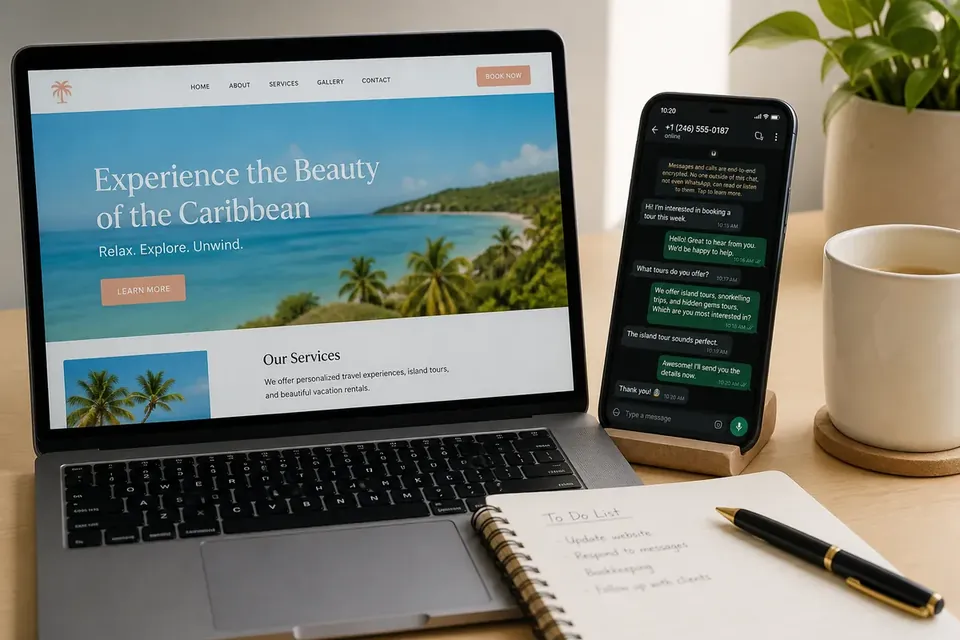
Paid social growth is real. Conversion infrastructure often is not. Across Caribbean tourism, events, retail, and services, the familiar pattern is a strong Instagram grid paired with a weak owned page: slow mobile load, unclear offer, no clean booking or RSVP path, and a phone number that rings into a personal WhatsApp with no hours, catalog, or handoff.
Hope Research Group flags WhatsApp as infrastructure, not a novelty channel. Penetration runs 84 to 92 percent across English-speaking markets. WhatsApp Business adoption among Caribbean SMEs hit 45 percent in 2025. The research treats Business features (catalogs, order confirmations, broadcast lists, support) as core mix, not optional chat. Brands that buy Meta reach and then bounce users into dead landing pages or unanswered DMs are paying for attention they cannot keep.
Internet penetration averages 74 percent regionally, from 42 percent in Haiti to 96 percent in Cayman. Mobile broadband exceeds 65 subscriptions per 100 people across much of the English-speaking Caribbean. Connectivity is no longer the primary excuse for thin owned surfaces. The gap is product and ops: who owns the post-click page, who answers WhatsApp within minutes, and who measures anything beyond platform-reported clicks.
That same owned-surface problem shows up in company reporting elsewhere on this blog. Our August 2026 Caribbean companies brief notes tourism operators that win with a clean booking or RSVP page plus WhatsApp-first support, not a brochure site. Freight-adjacent tools that cut phone tag still get attention even when the UI is plain. GigLink’s Techstars Port of Spain path sits in the same labour and marketplace stack where distribution without retention is expensive. Amber’s Jamaica cultural LLM work points at language and context layers that paid creative rarely funds even when short-form budgets rise.
Field note from Trinidad and Tobago
From T&T, Yatishara watches short-form Meta and TikTok spend collide with weak owned pages every week: traffic arrives, the site or link-in-bio fails the handoff, and WhatsApp becomes the real CRM by default. Surfaces like blog.yatishara.com and link.yatishara.com are examples of keeping narrative and offer pages on domains you control, not only inside rented feeds.
Implications without the brochure tone
-
Budget math. If Jamaica is ~US$280M and digital is mid-30s percent, English-speaking Caribbean digital is still measured in tens of millions per large market, not Silicon Valley scale. Concentration on Meta means creative and measurement habits travel island to island faster than radio buys do.
-
Age split. Under 35: TikTok and Instagram time dominate. Over 35: radio and local TV news still clear national reach. A single “Caribbean digital campaign” that ignores that split wastes money on both sides.
-
Cayman is not Jamaica. Cayman’s 52 percent digital share and 42 percent LinkedIn penetration among internet users reflect a financial-services expat market. Kingston and Port of Spain media mixes remain more radio- and TV-heavy in absolute terms even as digital grows.
-
Owned and WhatsApp are the missing attribution layer. Hope Research Group’s own recommendations stress mobile-first creative, WhatsApp in the core mix, selective radio, micro-influencers, and market-by-market localisation. None of that replaces a page that loads, states the offer, and routes the next message cleanly.
-
Projection risk. The path to 55 percent digital by 2030 is an extrapolation weighted by IMF Caribbean GDP assumptions. Oil-skewed growth in Guyana and uneven connectivity elsewhere will not distribute that digital share evenly. Channel forecasts are regional averages, not island forecasts.
Sources and method notes
Primary source for figures in this post: Caribbean Media Consumption & Advertising Research 2026, Hope Research Group, March 10, 2026. HRG cites ITU and telecom authorities for connectivity, DataReportal and Meta Ad Manager for platform penetration, regional broadcaster surveys for radio, streaming platform and telecom data for OTT, and its own media market model for 2025–2030 channel shares.
Sample guidance in the same brief: 400–800 respondents per market for national media estimates (±3.5–5 percent margin of error), larger samples for sub-demographic cuts. Methods include diaries, WhatsApp or SMS assisted surveys, social listening, retail ad-spend monitoring, and small-island cross-platform attribution. Treat agency “estimates” rows in the country table as modelled, not audited tax filings.
Caribbean ad spend in 2026 is a dual system: Meta and YouTube soak digital growth, while radio and local TV still hold the room for mass adult reach. The operators who convert that mix are usually the ones who treat owned pages and WhatsApp support as product, not as leftover design work after the media plan is locked.