 Yatishara Blog
WhatsApp-first Caribbean commerce: where the sale closes and the stack breaks
Caribbean merchants close sales in chat while landing pages and checkout lag. Hope’s ad-spend map, Meta’s business tools, GKMS WhatsApp Pay, and Wam’s hosted rails — with thin spots marked.
In much of the Caribbean, the storefront is not a Shopify theme. It is a green chat bubble. A customer sees a Meta ad, taps through to a thin landing page or an Instagram profile, then asks the real question on WhatsApp: price, size, delivery day, deposit. The merchant answers. The sale closes in the thread. Fulfilment and money movement happen somewhere else — bank transfer screenshot, cash on delivery, payment link, or a hosted checkout URL pasted mid-conversation.
That pattern is not a quirk. It is the operating system of a large share of Caribbean SME commerce. The editorial question for August 2026 is not whether WhatsApp matters. It is what happens when advertising budgets, owned digital surfaces, and payment rails are misaligned with where consent and cash actually meet.
This brief sticks to public research, company announcements, and primary product docs. Where regional measurement is thin, it says so. It is not a growth playbook and not a booking pitch.
Reporting framePaid traffic often dies on thin pages. The sale that survives usually lives in WhatsApp.
The spend lands on Meta; the close lands in chat
Hope Research Group’s 2026 Caribbean media consumption and advertising research puts regional ad spend near US$1.2 billion, with digital at about 38 percent of budgets — up from 22 percent in 2020. Inside digital, Hope attributes roughly 55 percent of Caribbean digital spend to Meta platforms. Jamaica and Trinidad and Tobago sit among the largest English-speaking advertiser markets in that map. Our fuller channel reading is in the Caribbean ad spend 2026 note.
Those numbers matter because Meta’s acquisition surfaces and WhatsApp’s conversation surfaces sit in the same company — and still break across product seams for many merchants. Ads buy attention. Catalogues and Click-to-WhatsApp ads can route intent into a Business account. But inventory truth, deposit logic, and settlement often remain human and improvised.
Caribbean Market Research’s 2026 consumer trends brief describes smartphone-heavy markets and puts mobile commerce at a majority of e-commerce transactions in Trinidad, Jamaica, and Barbados in its framing. Treat the precise percentages as research estimates, not a national accounts series — the directional claim is enough: phones are the default shopping device, and chat is the default negotiation layer.
What “WhatsApp-first” looks like on the ground
A typical Trinidad or Jamaica SME path looks like this:
- Creative runs on Facebook or Instagram.
- The buyer messages the Business number (or a personal number still used as a shop).
- Stock, variants, and delivery windows are confirmed in prose, sometimes with Status photos.
- Payment is requested via bank details, a third-party bill-pay product, a payment link, or a hosted checkout redirect.
- The merchant marks the order “paid” when a screenshot arrives or a webhook fires — if one exists.
Caribbean Signals, covering Meta’s business AI expansion in June 2026, put the same observation in plain language: for many Caribbean businesses WhatsApp is already the storefront, the service desk, and the booking system (caribbeansignals.com). BzHubb’s regional business coverage of Meta Business Agent and WhatsApp product changes makes the same structural point for smaller islands: customers already ask prices, place orders, and confirm bookings in chat (bzhubb.com).
What those pieces do not replace is a public, audited census of how many Caribbean merchants use WhatsApp Business App versus the Cloud API, how many use catalogues, and what share of GMV settles inside versus outside Meta’s stack. That measurement layer remains thin.
The owned-surface gap under the ads
Hope’s research and our own ad-spend brief both point at the same failure mode: digital budgets rose faster than owned commerce quality. Landing pages stay brochure-thin. Product pages lack live inventory. Support is an unpaid WhatsApp thread that brands treat as overflow rather than as the primary sales channel it already is.
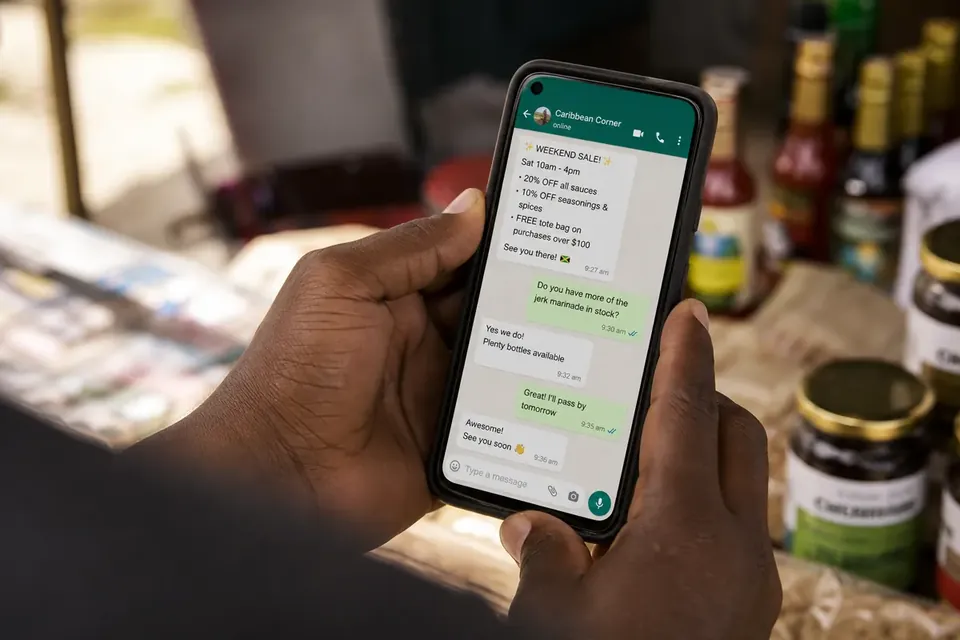

When the owned stack is weak, chat absorbs the work that a cart should do: clarifying size, holding a deposit, explaining bank fees, chasing proof of payment. That is efficient for trust and disastrous for analytics. Attribution stops at the message click. Repeat purchase lives in the merchant’s phone memory. Chargebacks and disputes lack a clean order object.
Caribbean Market Research notes that social commerce through WhatsApp and Instagram already shows up in holiday spending share in its Trinidad and Jamaica framing, while cash-on-delivery remains material for a slice of online buyers. Again: treat the exact shares as estimates. The operational implication is stable — many buyers still want human confirmation before money moves.
Payments that meet the chat, and payments that do not
Payment is where WhatsApp-first commerce either hardens into infrastructure or stays as theatre.
In Jamaica, GraceKennedy Money Services (Bill Express) publicly positioned a WhatsApp Pay path for bill payments, using WhatsApp as the access layer for a regulated payments brand rather than inventing a new consumer habit (jamaicaobserver.com). That is one pattern: meet the user in chat, settle on a licensed rail.
In Trinidad and Tobago, Wam’s public business and developer surfaces describe wallet acceptance, payment links, and hosted checkout via payment intents — a merchant server creates an intent, the buyer pays on Wam’s page, fulfilment keys off a signed webhook (docs.wam.money; consumer/business framing at wam.money and wam.money/business). Our Wam Pay Caribbean gateway brief covers that stack in more detail. Payment links are the WhatsApp-native surface; hosted checkout is the reliability surface when the order needs a proper payment object.
Regional rails are also splitting by country. Guyana’s Fast Pay go-live on 2 June 2026, using India-linked UPI architecture, changes the bank-to-bank story in that market even if it does not replace chat negotiation overnight. Context: Guyana Fast Pay / UPI. Instant RTP and wallet/card gateways solve overlapping but different merchant problems. Chat-first sellers need both conversation continuity and a settlement truth that is not a screenshot.
Meta’s business layer: agents, templates, and cost gravity
Meta continues to push WhatsApp from messaging into a business platform: catalogues, Click-to-WhatsApp ads, Status/Channels advertising experiments, usernames that reduce phone-number friction, and AI agents that can answer FAQs and qualify leads. Caribbean coverage of those shifts is already thick in trade blogs; primary product truth still lives on Meta’s Business and WhatsApp Business surfaces, which change faster than regional press can track.
For API users, cost gravity matters. Conversation and template pricing are country-coded and category-coded; Business Solution Providers sit between Meta and many SMEs. October 2026 messaging-policy changes have been widely reported in global BSP blogs as ending some free windows for service/utility traffic — treat exact tariffs as time-stamped and jurisdiction-specific, and verify against Meta’s current rate cards before budgeting. The Caribbean editorial point is simpler: when the sales channel is WhatsApp, messaging cost becomes part of cost of goods sold, not a marketing side expense.
GigLink’s Techstars-backed POS narrative in Barbados sits adjacent rather than identical: formalise the register and the payment moment, then connect digital demand. See GigLink / Techstars POS. WhatsApp-first SMEs often skip that register entirely until volume forces a system.
Cross-border and multi-currency friction
Caribbean merchants sell to diaspora relatives, cruise-week visitors, and regional buyers in other CARICOM currencies. Chat handles language and trust. Settlement does not. Cards decline. Local wallets do not span islands. Bank transfers require correct account names and patience. Hosted checkout and licensed remittance/bill-pay products are attempts to put a durable payment object under an informal sales conversation.
Diaspora buyers complicate returns and warranty threads: the person paying may not be the person receiving the goods. Merchants who only collect “name and address” in a WhatsApp note discover the gap when a parcel fails delivery. Structured order objects — even a simple invoice ID pasted beside the Wam or Bill Express link — are the minimum hygiene that separates a chat sale from an unrecoverable dispute. Tourism-week spikes (cruise calls, carnival, regatta) amplify the same failure mode at higher velocity; product rebuilds that sell yacht services or villa nights still close many bookings in chat before any PMS or marina system sees them (tourism product rebuild 2026).
Energy-hub and industrial desks are not irrelevant here. Trinidad’s services exporters and tourism-adjacent operators live in the same chat economy as retailers; capital projects and crew logistics also negotiate on WhatsApp even when the invoice later lands in email. Broader sector context: Trinidad as Caribbean energy hub and the August industries desk in Caribbean industries desk Aug 2026. Cultural and creative exporters — from short-form ads to film facilitation clients — inherit the identical close-in-chat pattern; see creative export / film offices for the institutional layer above those threads.
Field note: what chat-first looks like in studio ops
What to watch
Watch whether Meta’s Caribbean-facing Business Agent and catalogue tools reduce human reply load without breaking trust on deposits and complaints. Watch whether Hope’s next media wave shows owned-site quality catching up to digital spend — or whether WhatsApp continues to absorb the conversion layer. Watch whether Wam’s Caribbean merchant coverage and Guyana’s Fast Pay adoption change how often chat sales end in a bank screenshot versus a verified payment object. Watch BSP and Meta rate changes as they hit SME margins in Jamaica and T&T first.
For now, the citable core is straightforward. Caribbean advertising is already digital-heavy and Meta-concentrated (Hope Research Group). Commerce often closes in WhatsApp because that is where buyers and merchants already negotiate. Landing pages and checkout remain the lagging assets under that close. Payment products that paste cleanly into chat — links, bill-pay in-thread, hosted intents — are the practical bridge. Independent, region-wide GMV measurement of WhatsApp commerce is still thinner than the anecdote density. That is the accurate public picture in August 2026.