 Yatishara Blog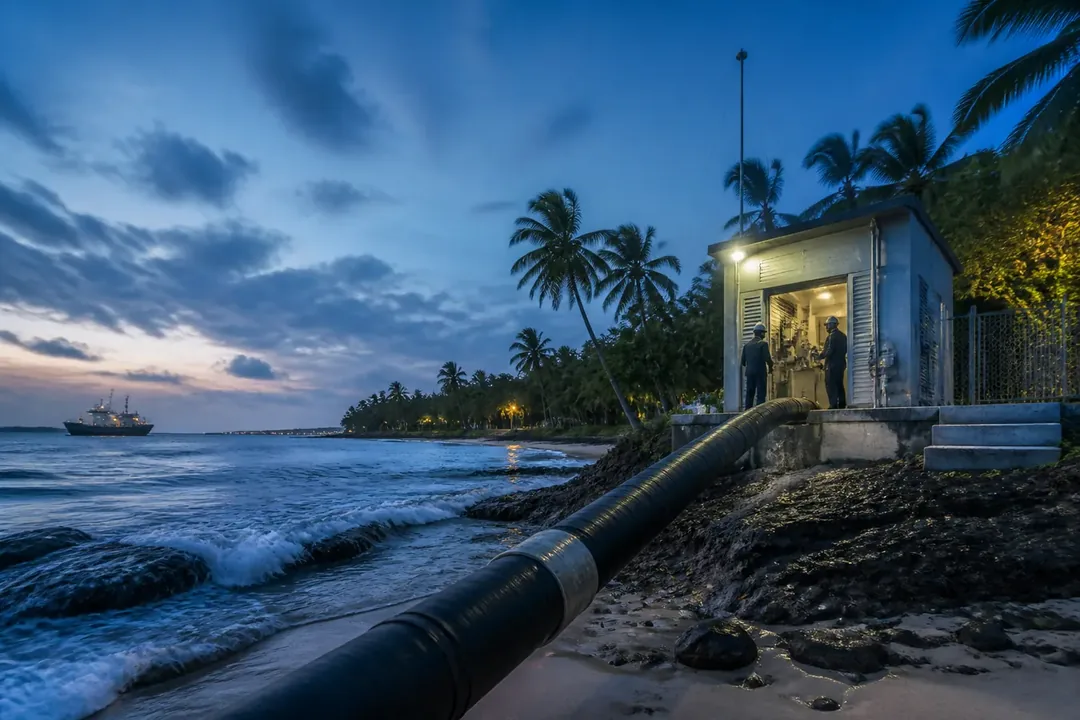
Subsea cables and island bandwidth: why Caribbean compute still leaves
ARCOS, ECFS, Digicel–Orange Deep Blue One, and the latency trombone through the United States. How landing stations, routing policy, and power grids decide whether AI and creative workloads stay in-region.
Caribbean digital work is usually sold as talent, accent, and time-zone. It runs on fibre in the seabed and electrons onshore. When a Port of Spain studio pushes a 4K master to a US CDN, or a Georgetown team trains a model on rented H100s in Virginia, the path is not “the internet.” It is a short list of cable systems, landing stations, IP transit contracts, and peering habits — many of which still send neighbouring-island traffic on a long detour through Florida before it comes home.
This brief is an infrastructure read for operators who buy bandwidth, host GPUs, or ship creative files. It sticks to published cable facts and measured routing quirks. It does not invent a new pan-Caribbean cloud.
Reporting frameCapacity on a cable and latency on a user path are different products. Islands can be fibre-rich and still compute-poor if traffic trombones north and power is diesel-priced.
The inherited ring: ARCOS and the Eastern Caribbean spine
The Americas Region Caribbean Optical-ring System — ARCOS-1 — has been in commercial service since September 2001. GeoCables and Submarine Networks describe an ~8,700 km ring with on the order of 24 landing points across roughly 15 countries, including Florida, Puerto Rico, Bahamas, Turks and Caicos, Dominican Republic, Curaçao, Venezuela, Colombia, and a Central American arc to Mexico (geocables.com/arcos; submarinenetworks.com ARCOS-1). Ring topology was the resilience thesis: traffic can reverse around a cut. At twenty-five years of design-life thinking, ARCOS is late-life infrastructure still carrying regional load — which is why upgrades, extensions, and parallel systems keep appearing in industry notes.
The Eastern Caribbean Fiber System (ECFS), ready for service in the mid-1990s on industry timelines, remains part of the legacy spine linking Eastern Caribbean islands. Digicel’s Deep Blue One materials explicitly treat ECFS, Americas-2, and related systems as the prior network Orange and Digicel already participated in. Legacy does not mean irrelevant. It means many islands still depend on ageing wet plant plus whatever new laterals and capacity upgrades operators finance.
Other named systems in regional coverage include ECLink and the Suriname–Guyana Submarine Cable System (SG-SCS). The point for a desk brief is not a complete atlas. It is that Caribbean bandwidth is a patchwork of rings, laterals, and national backhaul — not a single hyperscaler private cable the way a US coastal metro might feel.
Deep Blue One: new southern capacity, old routing habits
In May 2024, Digicel announced commercial launch of Deep Blue One, a roughly 2,000–2,250 km system connecting French Guiana, Suriname, Guyana, and Trinidad and Tobago. Landing points named in Data Center Dynamics and Submarine Networks coverage: Cayenne, Paramaribo, Georgetown, Chaguaramas, and Rockly Bay (Tobago). Branching units carry two to eight fibre pairs per segment with a stated minimum of 12 Tbps capacity per fibre pair. Orange is landing party in Cayenne and operates that station on Digicel’s behalf; Orange Marine laid the cable. Digicel Suriname reported traffic transition onto the new Suriname landing in August 2024. Industry cost figures circulated near US$80 million (datacenterdynamics.com; submarinenetworks.com Deep Blue One).
The oil-and-gas adjacency is intentional in Digicel’s framing: route design contemplated offshore connectivity as Guyana and neighbours boom. For Trinidad, new landings and a Trinidad–Tobago route segment matter because domestic redundancy and southern Caribbean exit diversity are not the same as more Miami capacity alone.
Then comes the awkward measurement. GeoCables notes that physical distance between Cayenne and Chaguaramas implies a latency floor near ~12 ms, while observed traffic latency remained on the order of 147–150 ms — more than twelvefold — consistent with traffic still routing via the United States rather than lighting a direct regional path (geocables.com/deep-blue-one). Cable existence is not routing policy. Until ISPs, CDNs, and enterprise WAN designs prefer the regional hop, neighbours stay logically far.
Why latency and compute leave the region
Three mechanisms push Caribbean workloads north even when wet plant improves.
1. Trombone routing. If the cheap or default IP path between Georgetown and Port of Spain still hairpins through Miami, application RTT looks like an international circuit. Databases, interactive edit suites, and agentic tool loops feel that delay as product failure.
2. Cloud gravity. Training clusters, object storage, and model APIs concentrate in Northern Virginia, Ohio, Dallas, and increasingly Latin American metros with denser peering. Caribbean teams rent those GPUs because the units exist there, the software stack is documented there, and egress pricing is a known devil. New subsea capacity helps download and upload. It does not summon an H200 rack.
3. Power and cooling economics. Continuous GPU load is an energy product. Many islands still price electricity around imported liquid fuels and thin reserve margins. Trinidad and Tobago’s gas-fired grid and industrial estates are the regional outlier for continuous heavy ops — mapped in our Trinidad energy hub brief. Fibre without affordable megawatts still exports compute.
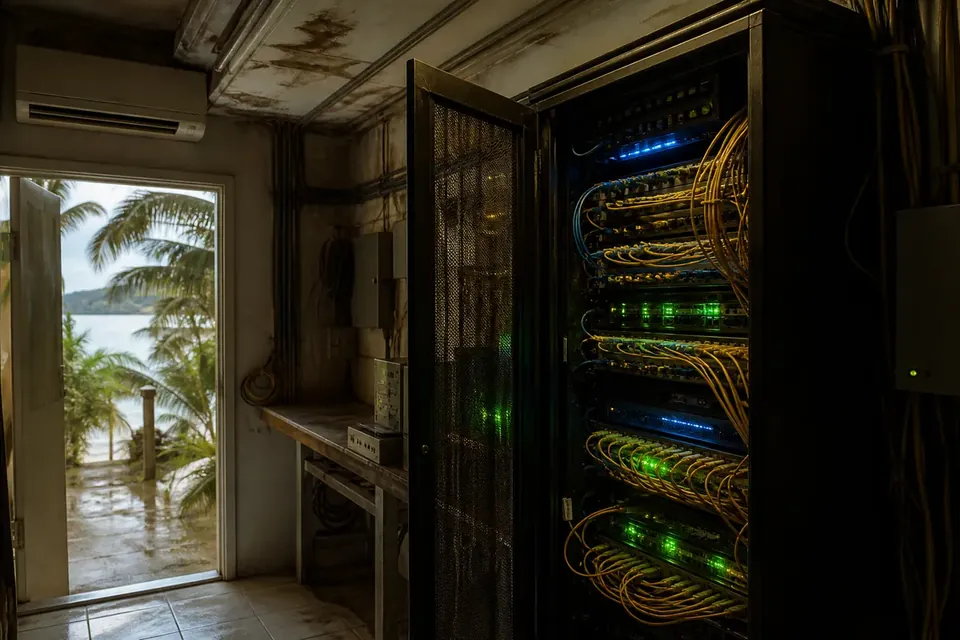
Creative production makes the same physics visible at smaller scale. Overnight renders, continuous cloud sync, live remote colour, and multi-island review sessions fail when packet delay and packet loss stack on top of generator brownouts. Agencies choose HQ cities for talent and client access — and for whether a 200 GB package uploads before the client call. Bandwidth marketing that quotes only peak Gbps without median latency and without power price is incomplete procurement advice.
Landing stations are politics and real estate
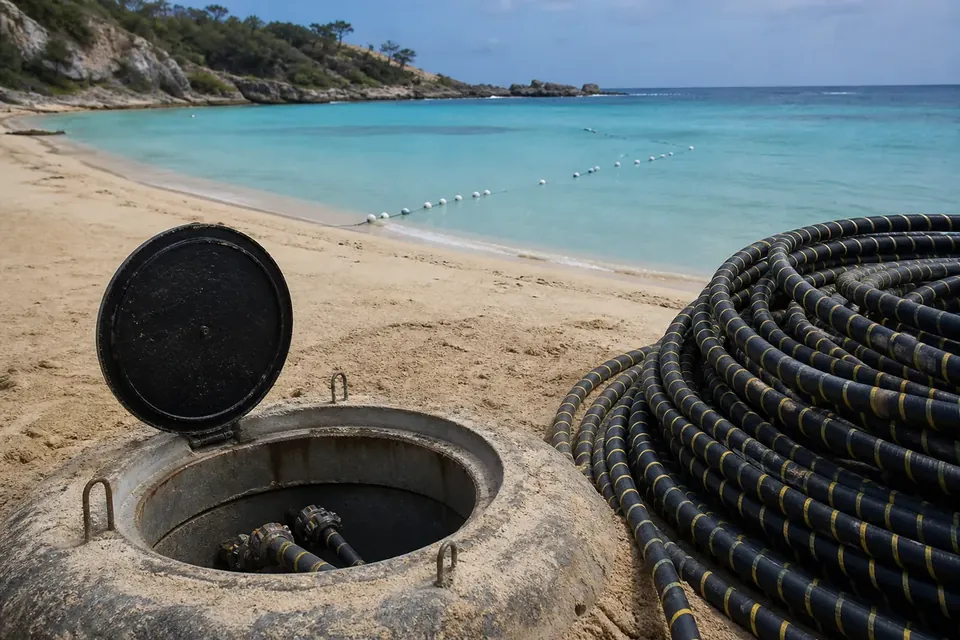
A cable landing station is not a metaphor. It is beach manhole, CLS building, power feed, security, customs for equipment, and regulated access for carriers. New landings in Trinidad and Tobago for Deep Blue One required permits and backhaul into national networks. Suriname’s August 2024 station go-live was a discrete project, not a software toggle. Islands that cannot site diverse landings remain one cut or one CLS fire away from isolation — ARCOS’s ring idea was invented for that failure mode, but ring membership is not universal across every CARICOM market.
Single-landing markets also lose commercial leverage. When only one wet path exits an island, wholesale IP pricing and repair priority follow the monopoly path. Dual landings on different systems — for example a legacy ring station plus a new southern lateral — change both resilience and bargaining. That is why Deep Blue One’s Trinidad and Tobago landings matter beyond marketing: they alter domestic redundancy between the islands and diversify southern exits, even if most consumer traffic still gravitates to US CDNs.
Repair economics reinforce the same geography. A cable cut in a busy US–Caribbean segment attracts ship time faster than a thin branch to a small island with limited traffic. Operators know this; insurance, SLA credits, and public outage narratives usually understate how long a remote lateral can wait. Capacity announcements without a maintenance and diversity story are incomplete infrastructure journalism.
Content delivery and financial-services latency add another layer. Card authorisation, wallet webhooks, and remittance cash-out messaging often terminate on US or European processors even when the merchant and buyer are both Caribbean. Payments stories on this desk — Wam’s Trinidad checkout rail, Guyana’s Fast Pay — still sit on top of this IP substrate. Instant domestic clearing does not erase the round-trip to a foreign fraud model if that is where the vendor hosts it.
Ad-tech and creative delivery show the same pattern. Regional campaigns billed in our Caribbean ad spend 2026 note still serve creatives and conversion pixels from global clouds. When upload of masters is slow and preview RTT is high, production teams quietly schedule overnight transfers and accept that “real-time collaboration” means someone is buffering. Fibre marketing that ignores that workflow is selling the wrong unit.
What “staying in-region” would actually require
A serious regional compute thesis needs concurrent progress on four tracks:
- Diverse wet plant into each major market, with documented RFS dates and upgrade roadmaps beyond a single legacy ring.
- Regional peering and CDN caches so popular paths do not default via Florida.
- Power priced and reliable enough for continuous racks — where Trinidad’s industrial energy stack remains the comparative advantage among English-speaking islands.
- Colocation and interconnect products that let carriers, clouds, and enterprises meet without shipping every packet to Ashburn.
Those four tracks rarely move together. A new cable without a peering policy change only lowers the theoretical floor. A peering festival without dual landings still fails on a cut. Cheap megawatts without interconnect leave racks stranded behind last-mile microwave. Hyperscaler Local Zone announcements without published interconnection pricing leave enterprises guessing. Desk coverage should score jurisdictions on the stack, not on a single press release.
Buildathon compute prizes that ship H200 access from foreign clouds — visible in regional programme coverage elsewhere on this blog — are rational given today’s gravity. They also advertise the gap: Caribbean coordination problems are being solved with Caribbean talent and non-Caribbean GPUs. That is a workable near-term pattern. It is not sovereignty. Oil-driven demand in Guyana will pull more low-latency paths toward Houston and London regardless of CARICOM preference; the question is whether Georgetown–Port of Spain ever becomes a first-class hop for regional SaaS rather than an afterthought.
What to watch
Watch whether Deep Blue One traffic matrices start showing direct southern Caribbean hops in independent measurements, not only in launch decks. Watch ARCOS life-extension and any Cuba or other branch politics that change the ring. Watch Guyana’s oil-driven demand for low-latency links to Houston and London as much as to Port of Spain. Watch whether any Caribbean market announces utility-scale colocation tied to gas or renewables rather than diesel. Watch CDN and cloud on-ramp announcements that name Bridgetown, Kingston, Port of Spain, or Georgetown as cache or Local Zone style presence — then verify with traceroute, not press.
For now, the citable core is physical and political. ARCOS-era rings still define much of the basin; Deep Blue One added southern capacity into Guyana and Trinidad in 2024; measured paths can remain Florida trombones; compute leaves because cloud gravity and power economics reinforce that routing. Island bandwidth is necessary. It is not sufficient.
Snapshot dated August 15, 2026. Prefer Submarine Networks / GeoCables / operator notices for RFS and landings; prefer independent latency measurements over brochure RTT.