 Yatishara Blog
Caribbean ports digitalisation: IMO single windows, PMAC benchmarks, and freight ops reality
Since January 2024, IMO FAL rules require Maritime Single Windows. PMAC’s 2026 digitalisation survey and Portside Caribbean reporting show Caribbean ports racing PCS, MSW, and cybersecurity — unevenly.
Caribbean trade still moves through cranes, pilots, and paper habits — even when the legal obligation is already digital. Under amendments to the International Maritime Organization’s Convention on Facilitation of International Maritime Traffic (FAL Convention), IMO Member States have been required to use Maritime Single Windows for the electronic exchange of ship arrival, stay, and departure information since 1 January 2024 (imo.org — Maritime Single Window). The rule is global. Implementation in Caribbean ports is not uniform.
This brief reads the public IMO record, Port Management Association of the Caribbean (PMAC) survey coverage, and Portside Caribbean’s 2025–2026 digitalisation reporting. It is not a vendor shortlist. Where island-by-island go-live dates are unpublished or contested, it marks the thin spot.
Reporting frameDigitalisation at the berth is a governance problem dressed as software: one submission, many agencies, one truth.
What the IMO actually mandated
The FAL Annex amendments require public authorities to establish, maintain, and use Maritime Single Window systems so that information for ship clearance is submitted electronically, coordinated across agencies, and reused rather than re-keyed (IMO MSW page; IMO newsroom explainer). In plain terms: the master, agent, or owner should not file the same dataset separately to customs, immigration, port health, and the harbour master if the single window is working.
IMO also publishes guidelines on setting up maritime single windows and on authentication, integrity, and confidentiality of MSW exchanges. At FAL 50 (March 2026), the Facilitation Committee approved an IMO Strategy on Maritime Digitalization aimed at interoperability, standardisation, data-sharing, and data governance, and adopted resolution language on accelerating MSW implementation that has been mandatory since 2024 (imo.org). Draft cybersecurity amendments for MSWs were approved for a later adoption track, with expected entry into force cited toward 1 January 2029 if the committee calendar holds — treat that date as committee-path dependent until adoption completes.
Caribbean readiness was already on the regional agenda before the deadline. In June 2023, IMO reported a PMAC AGM panel in Antigua and Barbuda on MSW compliance with the January 2024 mandate, with IDB, World Bank, and IAPH voices in the room (imo.org WhatsNew).
Why Caribbean ports feel the mandate differently
Island ports are not interchangeable. Some are regional transshipment nodes. Others are national gateways for fuel, containers, and cruise. Many combine small cargo volumes with high administrative complexity: limited IT teams, multiple border agencies, and dependency on shipping-agent workflows that evolved around PDF and email.

UNCTAD’s Review of Maritime Transport series has repeatedly tied Port Community Systems (PCS), Maritime Single Windows (MSW), and Trade Single Windows (TSW) to clearance-time and resilience outcomes. Portside Caribbean’s practical Caribbean framing cites that UNCTAD line alongside IMO and IDB guidance: digitalisation fails when platforms are built in isolation, processes are digitised without redesign, and institutional fragmentation blocks interoperability (portsidecaribbean.com). ECLAC’s earlier logistics digitalisation analysis for Latin America and the Caribbean made the same institutional point — platforms without process redesign and legal recognition underperform.
Trinidad and Tobago’s energy and services role sits adjacent to this logistics story. Port and industrial corridor reliability shapes how energy services, fabrication, and regional freight claims land in practice; see Trinidad energy hub and the wider August desk in Caribbean industries Aug 2026.
PMAC’s 2026 survey: from “whether” to “how fast”
Portside Caribbean’s write-up of the Caribbean Port Digitalisation Report – 2026 describes a PMAC Digitalisation Working Group survey lineage that began in 2024 and, by the 2026 edition, covers responses from 18 Caribbean territories. The editorial claim in that coverage is important: Caribbean ports are no longer debating whether digital transformation is necessary; the argument has moved to acceleration, systems connection, and data-driven operations (portsidecaribbean.com).
According to that report coverage:
- Port Community Systems and Maritime Single Windows remain high regional priorities because they connect organisations, not only digitise single terminals.
- Terminal Operating Systems (TOS) stay the operational backbone; priorities shift toward expanding PCS/MSW while keeping TOS investment.
- Implementation levels for PCS/MSW are described as relatively stable versus 2025 in the survey narrative — progress exists, but the hard work is integration and governance, not another pilot login screen.
- PMAC’s Digitalisation Working Group distilled six strategic priorities: regional collaboration, accelerating PCS and MSW, cybersecurity resilience, digital skills, systems integration, and preparing for AI-enabled operations.
Single window versus single inbox
A Maritime Single Window is not “we have a website.” It is a coordinated electronic channel where required FAL data is submitted once and distributed to the right authorities. A Port Community System is the broader community layer — terminals, agents, truckers, customs brokers, and sometimes inland logistics — sharing operational events around the call. A national Trade Single Window may cover goods clearance beyond the maritime call itself. Caribbean programmes often advance these layers on different clocks, which is why a vessel can clear digitally while cargo still waits on a parallel paper or email path.
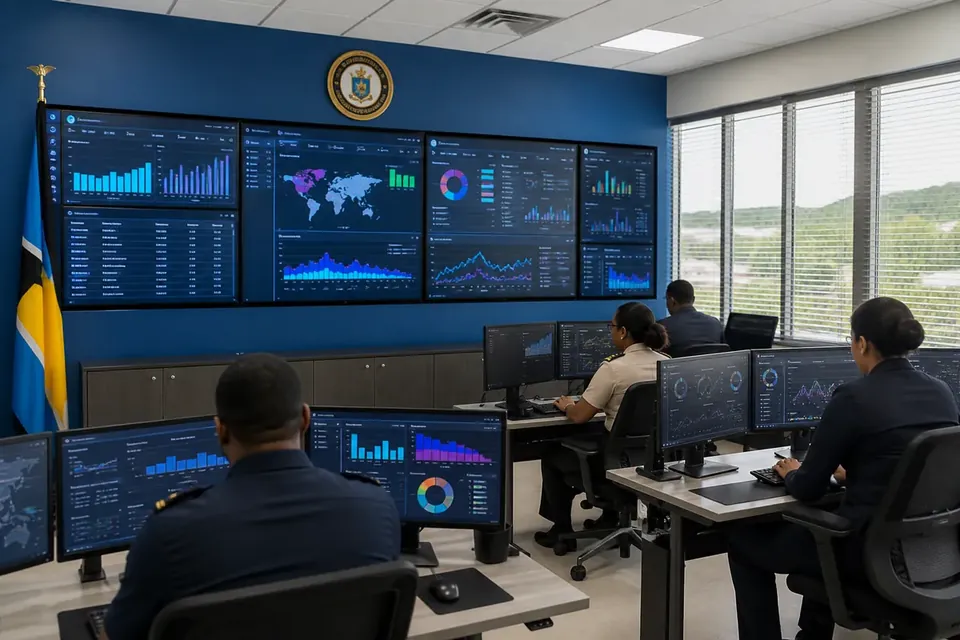
Interoperability is the regional prize and the regional risk. A digital corridor that connects national platforms is attractive for short-sea and feeder trade; Portside’s digitalisation coverage notes PMAC interest in connecting platforms, while also implying that corridor talk can outrun live interfaces. Treat “regional digital corridor” language as proposal-stage until named ports publish live API or exchange arrangements.
Cybersecurity is no longer a footnote. Once clearance truth lives in an MSW, availability and integrity become trade-critical. IMO’s FAL 50 cybersecurity amendment path for MSWs is the global signal; Caribbean ports with thin SOC capacity face a harder staffing problem than a licensing checkbox.
Freight ops: what digitalisation changes day to day
For freight operators and ship agents, mature digital stacks change the day in concrete ways:
- Pre-arrival data reuse cuts duplicate forms for immigration, customs, and port health.
- Berth and yard events in a PCS reduce phone-tag between terminal and trucker.
- Electronic invoices and release messages shrink “who has the DO?” loops.
- Better call data supports just-in-time arrival conversations — climate and fuel pressure make idle time expensive even for small islands.
Ship agents in multi-island itineraries feel the unevenness first. A feeder that clears cleanly in one capital and then waits on emailed crew lists in the next port does not experience “Caribbean digitalisation” as a single product. It experiences a patchwork of national MSW maturity. That is why PMAC’s survey emphasis on regional collaboration and systems integration is not soft diplomacy language — it is an operations complaint translated into a working-group priority list.
Cruise and cargo compete for the same berths and the same agency attention in several harbours. Digital passenger manifests and cargo declarations may ride different modules even when both are labelled “single window.” Facilitation committees care about FAL data classes; terminal managers care about gangway and crane schedules. A serious PCS tries to keep those clocks visible to each other without forcing every stakeholder onto one vendor UI.
What digitalisation does not automatically fix: physical draft limits, equipment shortages, labour disputes, or last-mile trucking. A perfect MSW on a congested yard is still a congested yard. UNCTAD and IAPH messaging has long separated facilitation gains from capacity investment; Caribbean reporting should keep that split honest.
Skills are the quiet bottleneck. PMAC’s 2026 priorities name digital skills beside cybersecurity. Small port authorities that outsource MSW hosting still need staff who can adjudicate exceptions, audit access logs, and explain to agents why a submission failed schema validation at 02:00. Without that staffing, “mandatory since 2024” becomes a compliance claim with manual side doors.
Payments and trade finance sit one layer out. Instant rails and wallet checkout stories — Guyana Fast Pay, Wam’s T&T gateway — matter to merchants and freight buyers, but they are not substitutes for customs and port community data standards. Ad-driven consumer demand, covered in Caribbean ad spend 2026, can fill containers; ports still decide how fast those containers clear. Tourism rebuilds that lean on yacht clearance — see the tourism product rebuild 2026 brief — also depend on the same facilitation culture: one electronic truth, reused across agencies, or the marina product dies at the immigration counter.
Thin spots in the public record
Several facts remain hard to pin from open sources alone:
- Exact MSW go-live status for every Caribbean IMO member port as of August 2026.
- Which national systems are true single windows versus digital forms front-ends.
- Comparable before/after clearance-time statistics published with methodology.
- The share of calls still cleared through parallel manual workarounds after “go-live.”
- Vendor concentration: how many Caribbean MSW/PCS deployments share the same platform family versus bespoke builds.
Those gaps are not excuses for ignoring the mandate. They are reasons to prefer dated primary notices from port authorities and customs over slide decks. Trade press summaries of PMAC surveys are valuable directional instruments; they are not a substitute for each port’s own statutory notice when a filing channel becomes mandatory for agents.
What to watch
Watch FAL 51 and the cybersecurity amendment adoption path for MSWs. Watch whether PMAC’s next survey shows PCS/MSW maturity moving from “priority” to measured interoperability across territories. Watch Trinidad, Jamaica, Barbados, and the Eastern Caribbean gateway ports for public notices that name live single-window URLs, mandatory electronic filing dates, and agent training cutovers. Watch whether AI-enabled operations language in the 2026 priorities stays aspirational or attaches to concrete TOS/PCS modules.
For now, the citable core is clear. IMO made Maritime Single Windows mandatory from 1 January 2024 (IMO). Caribbean ports, through PMAC’s multi-year survey work as reported in 2026, treat PCS and MSW as the connecting layer of modernisation, not a nice-to-have (Portside Caribbean). Freight reliability in the region will be decided as much by agency coordination and cybersecurity staffing as by crane hours. That is the accurate state of the public digitalisation story in August 2026.